Annual Report 2019

The Annual Report 2019 is now available and gives a good general view of the activities of the past year.

All projects are running successfully. The number of professional skills graduates, tuition centers and Back-to-School sponsorships has been increased. Besides that, additional abused women were taken care of. After the devastating cyclone in May 2019, Usthi provided emergency aid to over 1,000 families and started rebuilding the damaged campus. Moreover, investigation and collaboration agreement for the Nepal project were established to be able to start the program in early 2020. We wish you an exciting read!

Usthi would like to thank all donors who made our commitment to children and youths possible. We are very grateful for your blessings and participation.

The Annual Report 2019 and the Financial Report are available online for download.
For printed copies free of charge write to hallo@usthi.ch or call +41 55 511 21 25.
Usthi Foundation Annual Report 2019 for download as PDF.

Usthi Foundation Audit Report 2019 for download as PDF..

Besuch der Botschaftsdelegation in der Penthakata-Schule

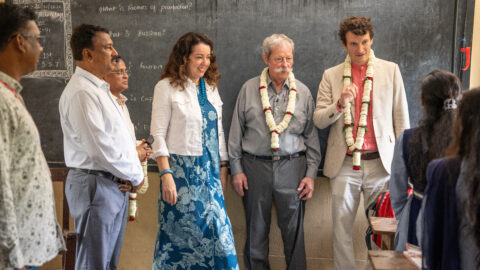
Swiss Ambassador Tissafi Visits Usthi

Three and a half days full of encounters, impressions and truly heartfelt moments in the Indian state of Odisha are now behind us. We are honoured and grateful for the visit of Maya Tissafi, Ambassador of Switzerland to India and Bhutan, and Simon Schäfer, First Secretary of the Swiss Embassy in New Delhi. Together with […]

Project Handover: Thaddeus School in Bhastara, India

The Thaddeus School began operating in 2006 with 45 small children. Since then, the school has grown significantly, received its own school building, and now teaches around 200 children from kindergarten to 10th grade. At the end of 2025, Usthi will hand over the project entirely to the Indian partner organization. A meaningful moment and […]

“I now feel I can dream again”

Despite economic growth, securing a livelihood remains a major challenge for many families in India. The majority of Indians work in the informal labor market, usually without social security or employment contracts and often under precarious working conditions. Access to the labor market and to fairly paid jobs is marked by glaring inequalities: women in […]